Energy Calibration
In this notebook, we determine the energy of the recoils within the absorber crystal. For this procedure, we need a peak in our spectrum that originates in a calibration source, i.e. a source of recoils with known energy. From this peak, we first calculate a CPE factor, that is a linear mapping between injected test pulse amplitudes and recoil energies. In the secons step, we do a polynomail fit between measured pulse heights and injected test pulse amplitudes, to account for nonlinearities in the detector signal.
import cait as ai
import numpy as np
import matplotlib.pyplot as plt
from scipy.stats import norm, expon
%config InlineBackend.figure_formats = ['svg']  # we need this for a suitable resolution of the plots
path_data = 'test_data/'
fname = 'test_001'
channels_rdt = [0,1]
channels_h5 = [0,1]
down=4
dh = ai.DataHandler(channels=channels_rdt)
dh.set_filepath(path_h5=path_data,
                fname=fname,
                appendix=False)  # this specifies, that the file does not have a "-P_Ch0..." appendix
DataHandler Instance created.
Rate and Stability Cuts
Before we can start with the energy calibration, we need to do several checks on our data. First, is the trigger rate stabile over the measurement time?
dh.show_values(group='events', key='hours', bins=12,
               xlabel='Time (h)', ylabel='Counts / 10 minutes', title='Event Rate')
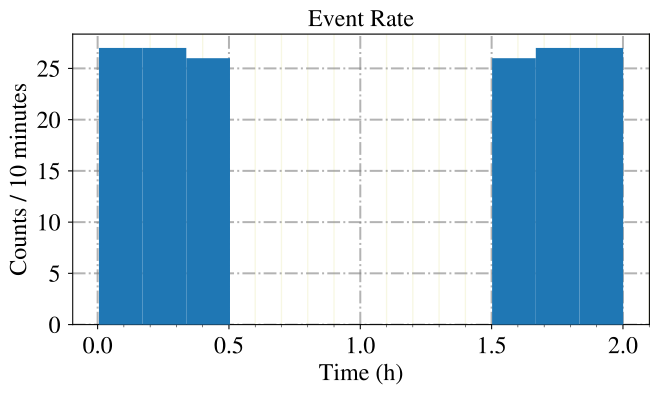
The gap in the histogram above is due to the fact that we use a file that was merged from two consecutive measurements (simulation, actually, in our case). Away from the gap the trigger rate is stable. The second check is, if the control pulse heights are stable.
dh.show_scatter(groups=['controlpulses', 'controlpulses'],
                        keys=['hours', 'pulse_height'],
                        idx0s=[None, 0],
                        xlabel='Time (h)',
                        ylabel='Control Pulse Height (V)',
                        yran=(-0.5, 12),
                        title='Control Pulse Stability'
                        )
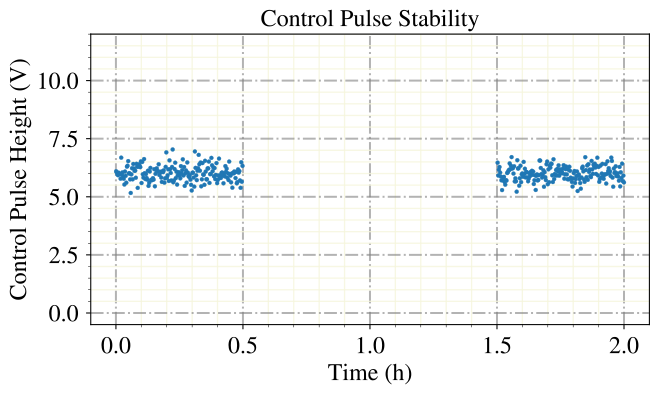
Well, they are. Other than for the control pulses in the CSMPL files (which we saw in the previous notebook), we included some variations for the control pulses in the hardware data files, to demonstrate a stability plot and cut. But first we also look at the stability of the test pulses.
for c in [0,1]:
    dh.show_scatter(groups=['testpulses', 'testpulses'],
                    keys=['hours', 'mainpar'],
                    idx0s=[None, c],
                    idx2s=[None, 0],
                    xlabel='Time (h)',
                    ylabel='Pulse Height (V)',
                    marker='.',
                    title='Channel {} Test Pulse Stability'.format(c)
                    )
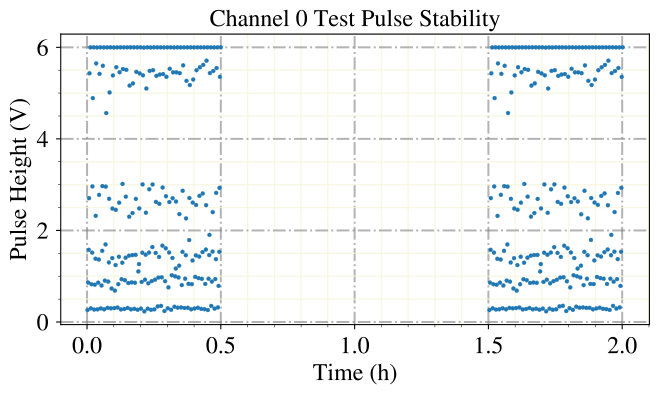
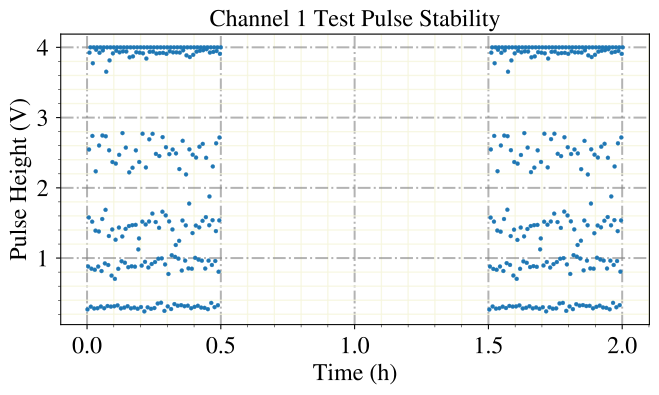
All stable. However, jsut for demonstration purposes, we can calculate a stability cut on the control pulses. For this we add a flag to the events group in the HDF5 file, that determines if the event is in between two stable control pulses. A control pulses is defined as stable if its height does not exceed the upper and lower bounds and does not deviate more than significance * sigma from the mean control pulse height. Here we ignore single outliers.
dh.calc_controlpulse_stability(channel=0, significance=3, lb=5, ub=7.5)
Do Testpulse Stability Cut
Control Pulse PH 6.006 +- 0.314, within 3 sigma: 99.750 %
Good Control Pulses: 399/400 (99.750%)
Good Events: 158/160 (98.750%)
Good Time: 0.993h/2.000h (49.667%)
The same we can do for the rate, where we flag all events as bad that are not in 10-minute intervals with a rate that does not exceed bounds and does not deviate more than sigma * significance from the average rate.
dh.calc_rate_cut()
Do Rate Cut.
Rate Median: 26.5/10m
Good Rate per 10m (3 sigma): 12.0 - 43.0
Good Events: 159.000/160.000 (99.375%)
Good Controlpulses: 400.000/400.000 (100.000%)
Good Testpulses: 479.000/480.000 (99.792%)
We can later access these cut flags with the dh.get(group=’events’, dataset=’controlpulse_stability’) and dh.get(group=’events’, dataset=’rate_cut’) methods and include them in any cuts we want.
Find CPE Factor
We proceed now with calculating the CPE factor, the linear mapping between injected test pulse amplitude and recoil energy. We want to do this for both our channels.
channels = [0, 1]
The first necessary step is to determine the position of the calibration peaks, for this we plot the spectra.
for c in channels:
    dh.show_values(group='events', key='sev_fit_par_down{}'.format(down), bins=50, idx0=c, idx2=0, range=(0, 10),
               xlabel='Pulse Height (V)', ylabel='Counts')
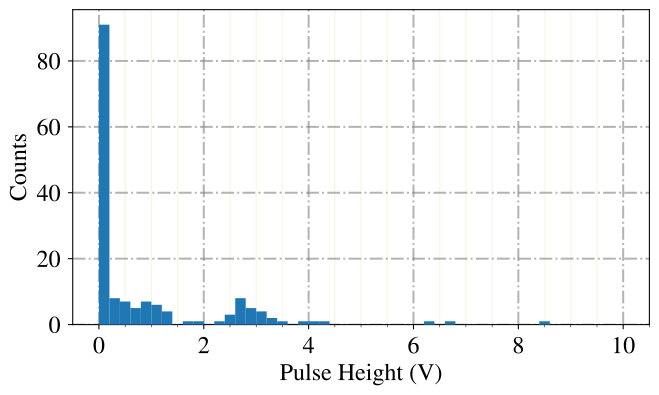
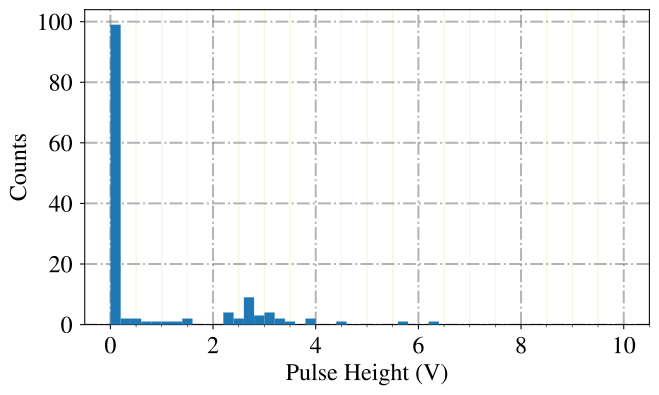
We determine their positions as the mean value within given bounds.
ph = dh.get('events','sev_fit_par_down{}'.format(down))[:, :, 0]
lb = [2.5, 2]
ub = [4, 4]
calibration_peak = []

for c in channels:
    peak_events = ai.cuts.LogicalCut(initial_condition=ph[c]>lb[c])
    peak_events.add_condition(ph[c]<ub[c])

    calibration_peak.append(np.mean(ph[c, peak_events.get_idx()]))
    print('Peak position with PH: ', calibration_peak[-1])
Peak position with PH:  2.9504719516990905
Peak position with PH:  2.8555939857505446
Second step is to determine the position of the two neighbouring test pulses, because we want to perform a linear interpolation between them. Again we determine the rough position by looking at the spectrum.
for c in channels:
    dh.show_values(group='testpulses', key='sev_fit_par_down{}'.format(down), bins=150, idx0=c, idx2=0,
                   xlabel='Pulse Height (V)', ylabel='Counts', range=(0,6))
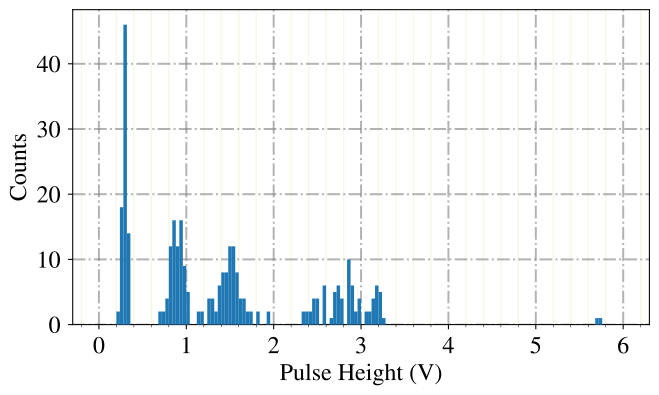
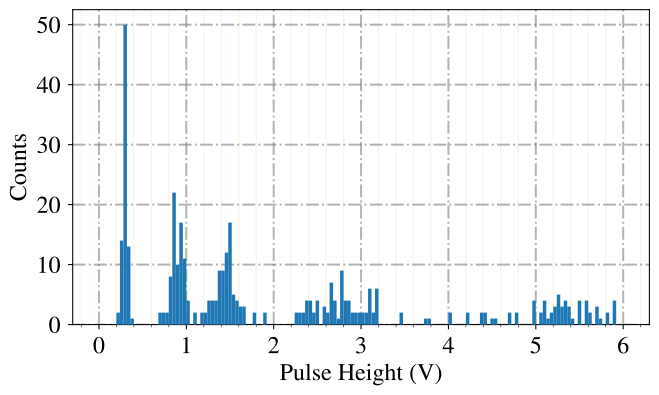
Then we determine their precise position as mean within value within given bounds.
ph_tp = dh.get('testpulses','sev_fit_par_down{}'.format(down))[:, :, 0]
tpas = dh.get('testpulses','testpulseamplitude')

print('Unique TPAs: ', np.unique(tpas))
Unique TPAs: [ 0.1 0.30000001 0.5 1. 3. 10. ]
tpa_peaks = []
lower_bounds = [1.2, 2.4]
upper_bounds = [1.8, 3.3]
two_tpas = [0.5, 1]

for c in channels:
    two_peaks = []
    for i, val in enumerate(two_tpas):
        peak_events = ai.cuts.LogicalCut(initial_condition=ph_tp[c] > lower_bounds[i])
        peak_events.add_condition(ph_tp[c] < upper_bounds[i])
        peak_events.add_condition(np.isclose(tpas, val))
        two_peaks.append(np.mean(ph_tp[c, peak_events.get_idx()]))
        print('Channel {}: Peak position TPA {} from {} events, with SEF: {}'.format(c, val, len(peak_events.get_idx()), two_peaks[-1]))
    tpa_peaks.append(two_peaks)
Channel 0: Peak position TPA 0.5 from 76 events, with SEF: 1.4882755980233209
Channel 0: Peak position TPA 1 from 74 events, with SEF: 2.851255677995759
Channel 1: Peak position TPA 0.5 from 78 events, with SEF: 1.4566816419547235
Channel 1: Peak position TPA 1 from 68 events, with SEF: 2.8131681276866916
Finally, we perform a linear interpolation between the neighbouring test pulses and determine by that an equivalent TPA value for the calibration peak. The CPE factor is then just the ratio between the calibration peaks energy and equivalent TPA value.
energy_calibration_peak = 5.89  # iron line
cpe_factor = []

for c in channels:
    tpa_calibration_peak = two_tpas[0] + (calibration_peak[c] - tpa_peaks[c][0])*(two_tpas[1] - two_tpas[0])/(tpa_peaks[c][1] - tpa_peaks[c][0])
    print('Channel {}: The TPA corresponding to the calibration peak is {} V.'.format(c, tpa_calibration_peak))
    cpe_factor.append(energy_calibration_peak / tpa_calibration_peak)
    print('Channel {}: The CPE factor is then {} keV/V.'.format(c, cpe_factor[-1]))
Channel 0: The TPA corresponding to the calibration peak is 1.0363968172247013 V.
Channel 0: The CPE factor is then 5.683151378033408 keV/V.
Channel 1: The TPA corresponding to the calibration peak is 1.0156381425506646 V.
Channel 1: The CPE factor is then 5.799309570245073 keV/V.
This was however the easy part. The harder part is to find an equivalent TPA value for each recoil event. This is done below.
Energy Calibration
for c in channels:
    dh.show_saturation(channel=c, method='sef', name_appendix_tp='_down{}'.format(down),
                       show_fit=False, s=10, title='Testpulse Saturation')
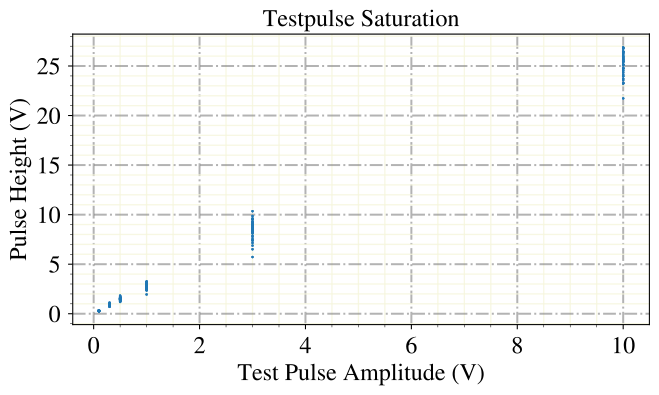
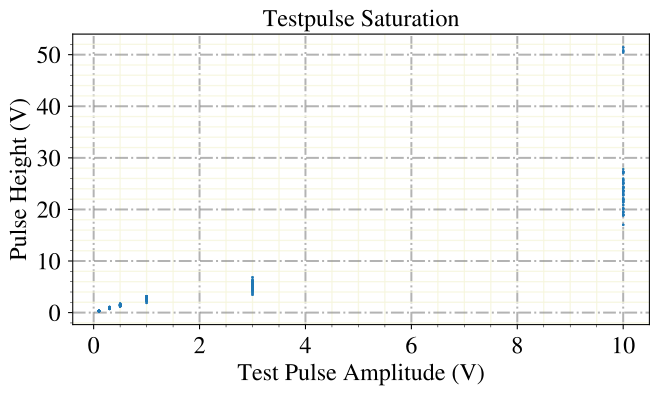
To calibrate the recoil energy, we use the test pulses. We do not want to spoil the calibration by pile-up events or outliers, therefore we first calculate a stability cut on the test pulses and flag all unstable test pulses as such.
Here, we could also provide bounds for all test pulse values of all channels, to individually remove outlying pulses. As we see in above plot, this is not necessary for our data. In above plot we see, that the high energetic test pulses are saturated on top and therefore have all the very same height. This would not be the care for real measured data and it just an effect of our augmentation of saturation in the mock data.
for c in channels:
    dh.calc_testpulse_stability(c, significance=2, ub = None, lb = None)
Do Control Pulse Stability Cut
Unique TPAs:  [ 0.1         0.30000001  0.5         1.          3.         10.        ]
Testpulses after Noise Cut: 480/480 (100.000%)
TPA 0.100 with PH 0.293 +- 0.026, within 2 sigma: 90.000 %
TPA 0.300 with PH 0.886 +- 0.082, within 2 sigma: 95.000 %
TPA 0.500 with PH 1.462 +- 0.129, within 2 sigma: 95.000 %
TPA 1.000 with PH 2.654 +- 0.246, within 2 sigma: 97.500 %
TPA 3.000 with PH 5.393 +- 0.214, within 2 sigma: 95.000 %
TPA 10.000 with PH 5.999 +- 0.001, within 2 sigma: 96.250 %
Good Testpulses: 455/480 (94.792%)
Good Events: 152/160 (95.000%)
Good Time: 0.942h/2.002h (47.044%)
Do Control Pulse Stability Cut
Unique TPAs:  [ 0.1         0.30000001  0.5         1.          3.         10.        ]
Testpulses after Noise Cut: 480/480 (100.000%)
TPA 0.100 with PH 0.303 +- 0.027, within 2 sigma: 90.000 %
TPA 0.300 with PH 0.906 +- 0.082, within 2 sigma: 95.000 %
TPA 0.500 with PH 1.468 +- 0.122, within 2 sigma: 95.000 %
TPA 1.000 with PH 2.503 +- 0.195, within 2 sigma: 97.500 %
TPA 3.000 with PH 3.910 +- 0.058, within 2 sigma: 95.000 %
TPA 10.000 with PH 4.000 +- 0.000, within 2 sigma: 95.000 %
Good Testpulses: 454/480 (94.583%)
Good Events: 152/160 (95.000%)
Good Time: 0.940h/2.002h (46.961%)
The precise determination of equivalent TPA values for each pulse height we do as follows:
We use an interpolation method to determine an time continuous pulse height estimator for each individual injected test pulse amplitude. We calculate the uncertainty of the interpolation as a prediction interval.
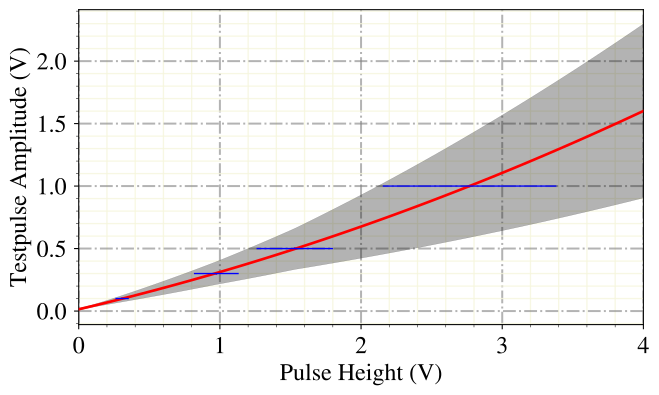
Then we fit a higher order polynomial at the exact time of each recoil to the Pulse Height/TPA values of the test pulses. By evaluating the polynomial at recoil time, we find an equivalent TPA value for the recoil pulse height. This we can linearly map with the CPE factor to a recoil energy. Also in this fit we include uncertainties, although the used procedure is more involved, as we have uncertainties in our independent rather than in the depending values. We can still accomplish this, by using an orthogonal distance regression, instead of an ordinary least squares regression and linear error propagation for the prediction interval.
This procedure is fully automated in below method. We have implemented as interpolation methods a gradient boosted regression tree on the 0.5 and +/- 1 sigma quantiles, and a simple linear interpolation, the second one we use here. We also need to define the start of the saturation and the order of the polynomial we want to fit.
dh.calc_calibration(starts_saturation=[4,3],
                    cpe_factor=cpe_factor,
                    plot=True,
                    only_stable=True,
                    # interpolation_method='tree',
                    interpolation_method='linear',
                    poly_order=2,
                    method='sef',
                    name_appendix_ev='_down{}'.format(down),
                    name_appendix_tp='_down{}'.format(down),
                    n_estimators=4,
                    )
Energy Calibration for Channel  0
PulserModel instance created.
Unique TPAs:  [ 0.1         0.30000001  0.5         1.          3.         10.        ]
Intervals seperated by 0.5 h: [[0.0016666667070239782, 1.5033333333736907], [1.5033333333736907, 2.001666666666667]]
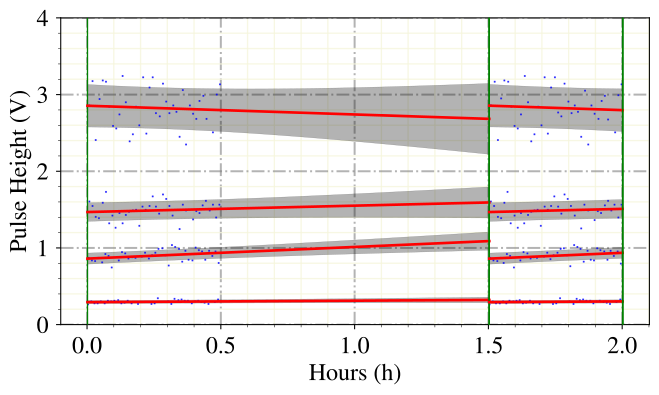
Plot Regression Polynomial at 0.751 hours.
Energy Calibration for Channel  1
PulserModel instance created.
Unique TPAs:  [ 0.1         0.30000001  0.5         1.          3.         10.        ]
Intervals seperated by 0.5 h: [[0.0016666667070239782, 1.5033333333736907], [1.5033333333736907, 2.001666666666667]]
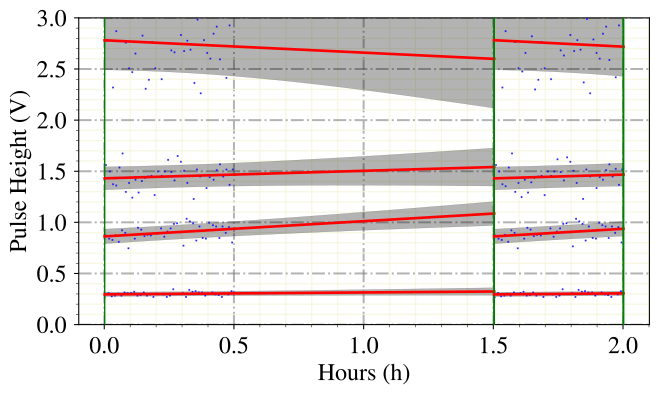
Plot Regression Polynomial at 0.751 hours.
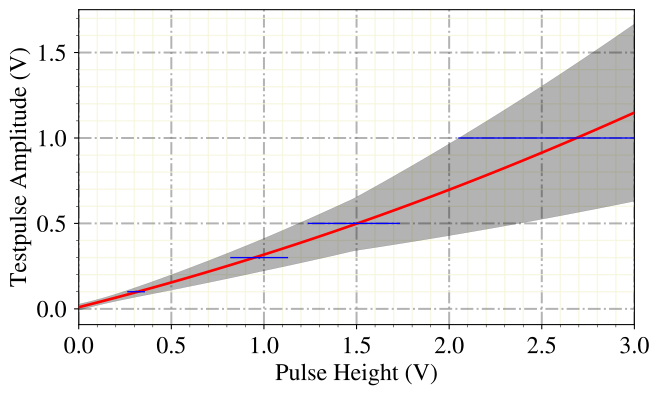
Finished.
We see now that there are two new dataset in the events group in the HDF5 file, ‘recoil_energy’ and ‘recoil_energy_sigma’.
dh.keys('events')
['add_mainpar', 'controlpulse_stability', 'decay_time_cut', 'event', 'hours', 'mainpar', 'of_ph', 'origin', 'pca_components', 'pca_error', 'pca_projection', 'rate_cut', 'recoil_energy', 'recoil_energy_sigma', 'sev_fit_par_down4', 'sev_fit_rms_down4', 'testpulse_stability', 'time_mus', 'time_s', 'tpa_equivalent', 'tpa_equivalent_sigma']
So lets plot the spectrum of these two channels. We gonna use the cut on the decay time we did in a prior notebook, to plot the spectrum only for the absorber events.
absorbers = dh.get('events', 'decay_time_cut')[0]

for c in channels:
    dh.show_values(group='events', key='recoil_energy', bins=50, idx0=c,
                   xlabel='Recoil Energy (keV)', ylabel='Counts', cut_flag=absorbers)
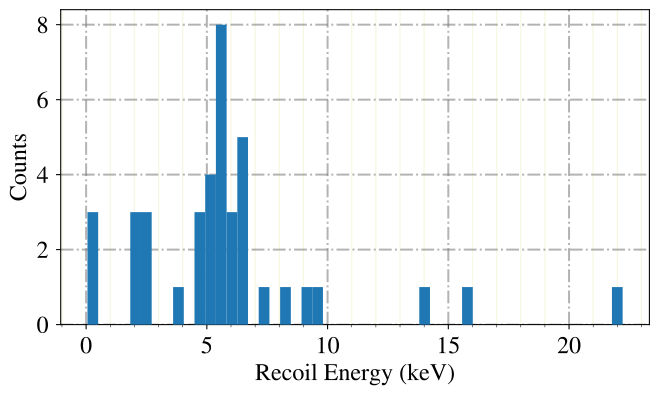
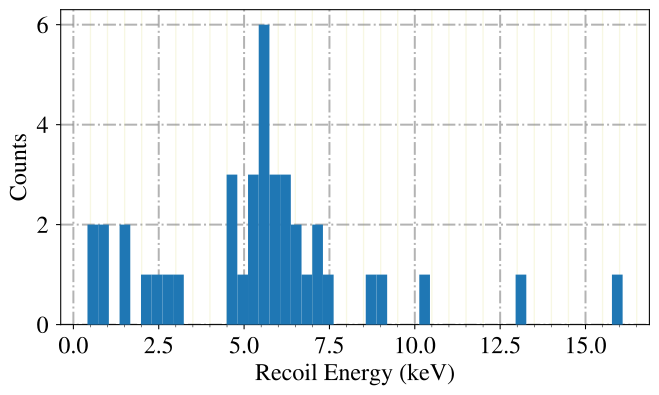
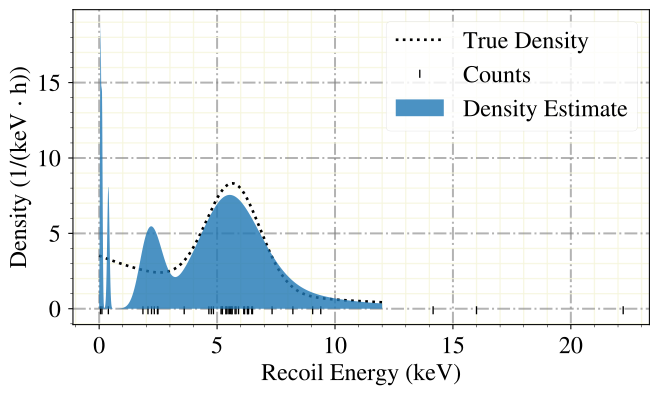
A more beautiful plot can be done with a kernel density estimation on the histogram. Here we replace every event by a Gaussian with the estimated sigma from the energy calibration times a scaling factor.
energy_phonon = dh.get('events', 'recoil_energy')[0]
energy_phonon_sigma = dh.get('events', 'recoil_energy_sigma')[0]

# density estimation
x_d = np.linspace(0, 12, 1000)
density = sum(norm(loc=m, scale=s).pdf(x_d) for m,s in zip(energy_phonon[absorbers], 0.3*energy_phonon_sigma[absorbers]))

# true density
nmbr_events = len(energy_phonon[absorbers])
density_source = 0.5*nmbr_events*norm(loc=1*cpe_factor[0], scale=(0.1+0.1)*cpe_factor[0]).pdf(x_d)
density_excess = 0.5*nmbr_events*expon(scale=cpe_factor[0]).pdf(x_d)
density_true = density_source + density_excess


plt.close()
ai.styles.use_cait_style(dpi=150)
plt.fill_between(x_d, density, alpha=0.8, zorder=25, label='Density Estimate')
plt.plot(x_d, density_true, linewidth=2, color='black', linestyle='dotted', label='True Density')
plt.plot(energy_phonon[absorbers], np.full_like(energy_phonon[absorbers], -0.1), '|k', markeredgewidth=1, label='Counts')
ai.styles.make_grid()
plt.xlabel('Recoil Energy (keV)')
plt.ylabel('Density (1/(keV $\cdot$ h))')
plt.legend()
plt.show()
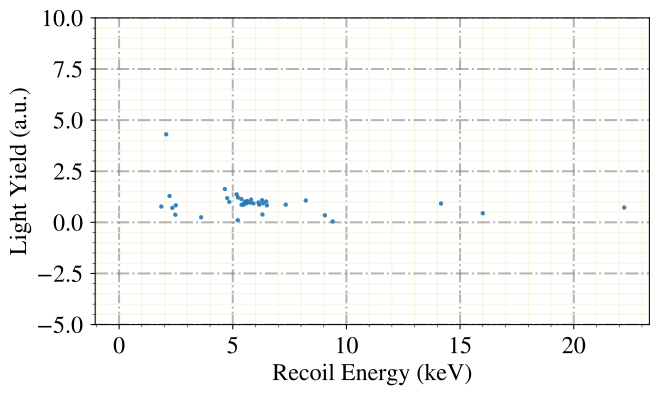
We can also do a light yield plot.
energy_light = dh.get('events', 'recoil_energy')[1]

plt.close()
ai.styles.use_cait_style(dpi=150)
plt.scatter(energy_phonon[absorbers], energy_light[absorbers]/energy_phonon[absorbers], marker='.', alpha=0.9, zorder=10)
ai.styles.make_grid()
plt.xlabel('Recoil Energy (keV)')
plt.ylabel('Light Yield (a.u.)')
plt.ylim([-5,10])
plt.show()
We now want to write the energies to an XY file, such that we can do limit calculations in other programs, e.g. in Romeo.
ai.data.write_xy_file(filepath='test_data/spectrum.txt',
                     data=[energy_phonon[absorbers],
                           energy_light[absorbers]/energy_phonon[absorbers],
                           energy_phonon_sigma[absorbers]],
                     title='Test Data Spectrum',
                     axis=['Recoil Energy (keV)',
                           'Light Yield (a.u.)',
                           'Recoil Energy Sigma (keV)'])
Start write.
File written.
Please forward questions and correspondence about this notebook to felix.wagner(at)oeaw.ac.at.